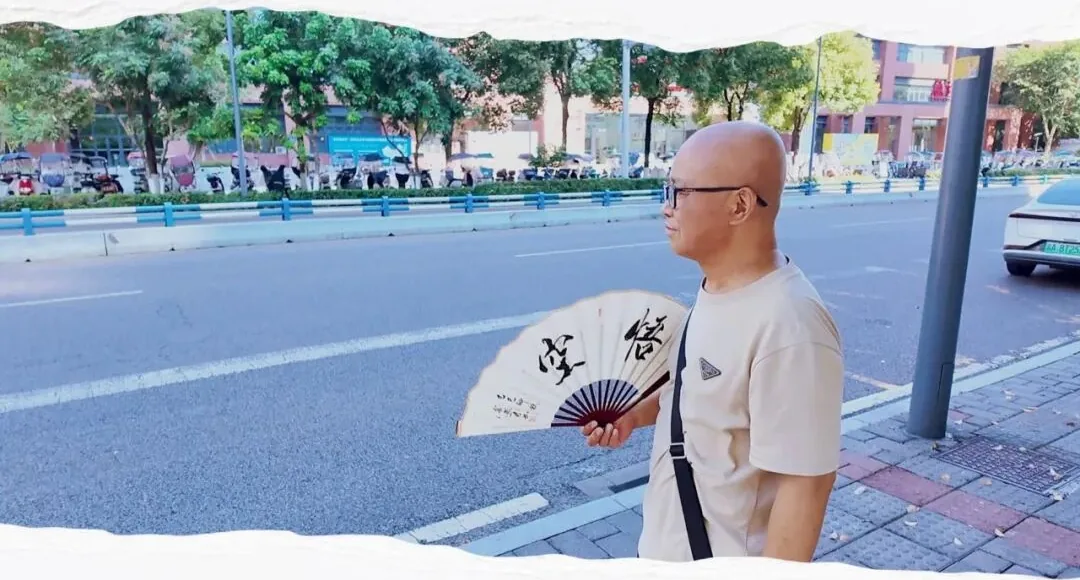
Mr. Shi, nine years after his lung cancer diagnosis, on an ordinary afternoon in Chongqing.
There is nothing dramatic about the way Mr. Shi lives with cancer. He is not chasing a miracle, and he has never been told his tumors have vanished. What he has done, for nine straight years, is show up: on time for admission, on time for treatment, on time for discharge — and then go home and live an ordinary life.
"In the morning I sit at home for a while. In the afternoon I play cards. Life is life — you live it the way it comes," he said.
That ordinariness is, in its own way, the point. Behind it sits a case that tracks almost a decade of progress in lung cancer care in China — and a patient who decided early on that a terminal label was not going to run his calendar.
2017: One CT Scan Changed Everything
In August 2017, Mr. Shi went to hospital for chest discomfort. A chest CT showed a mass in the upper lobe of his right lung. He underwent thoracoscopic right upper lobectomy with mediastinal lymph node dissection.
The pathology report came back as right lung adenocarcinoma — 70 percent acinar pattern and 30 percent solid pattern — staged pT2aN2M0, stage IIIA. The cancer had already spread to the mediastinal lymph nodes.
After surgery he completed four cycles of adjuvant chemotherapy with docetaxel and nedaplatin. Genomic testing found no targetable driver mutation, which closed the door on targeted therapy. So he took the other road available at the time and began chemotherapy.
"When I was diagnosed, I was actually fine. My mindset was good — I wasn't afraid. There was no other option anyway, so I just listened to the doctors."
Seven Years Later: From Stage IIIA to Stage IV
Roughly seven years after surgery, a follow-up chest CT showed multiple nodules in both lungs, new compared with previous imaging. PET-CT confirmed the worst reading: tumor recurrence with bilateral pulmonary metastasis, plus early metastatic signs in the station 2R mediastinal lymph nodes. His clinical stage was revised to rT0M1 — stage IV.
Advanced lung cancer. Four words that flatten many people. Mr. Shi kept his footing.
"Look — this is Wukong. That is my screen name," he said, pointing to the calligraphy on his folding fan. "Sun Wukong had seventy-two transformations. No demon scared him. Our mindset should be like that too — empty. Don't box yourself in. Don't frighten yourself."
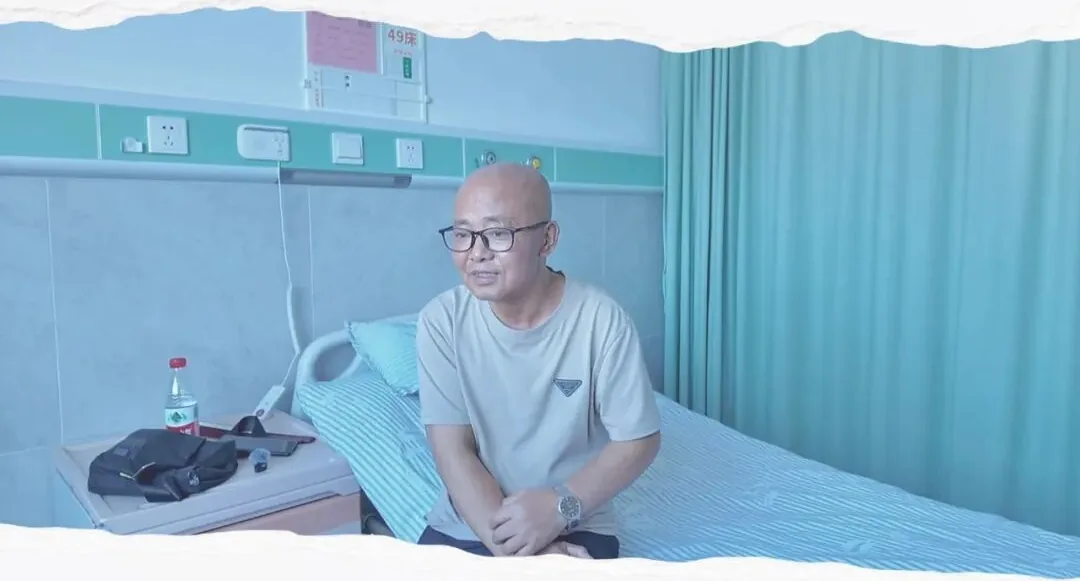
Between cycles, Mr. Shi's routine is deliberately unremarkable — admission, treatment, discharge, home.
A New Plan: Immunotherapy Plus Chemotherapy
Facing recurrence with metastatic spread, the team led by Director Luo Kuo, head of the Oncology Center at Chongqing HYGEIA Hospital, built a new regimen around the latest CSCO guidelines: immunotherapy combined with chemotherapy.
"Mr. Shi's situation involves multiple metastatic lesions in the lung, which rules out precise local treatment. Systemic drug therapy is the only viable route," Director Luo explained. "We used tislelizumab combined with pemetrexed disodium and cisplatin."
From February to May 2025, Mr. Shi completed four cycles of the combination. He then moved into long-term maintenance therapy — once every three weeks, without fail. By this latest discharge he had completed 18 maintenance cycles, with stable disease and no significant tumor progression.
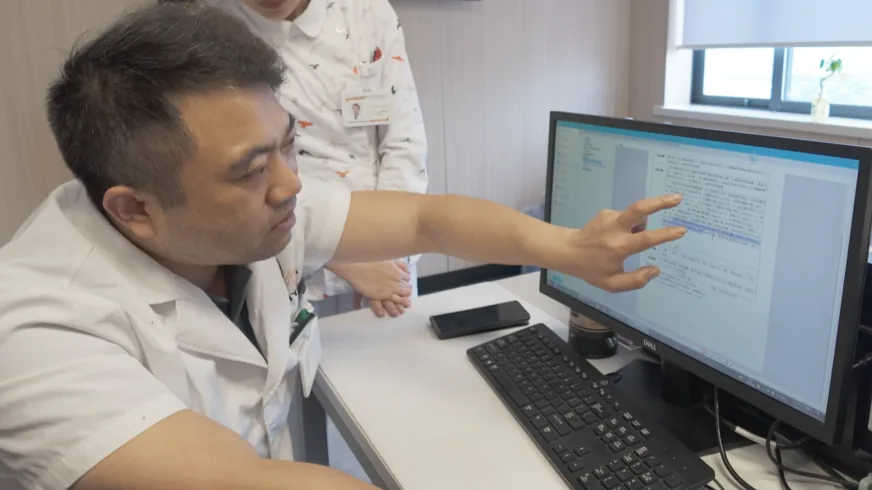
Director Luo Kuo reviews follow-up imaging. Recurrence after seven years of remission called for a systemic strategy, not local treatment.
"We no longer treat cancer as an incurable disease. We treat it as a chronic disease that can be managed," Director Luo said. "Patients like Mr. Shi give us doctors enormous confidence — and they give other patients enormous encouragement."
Living Like Everyone Else
Apart from scheduled admissions, Mr. Shi's life looks like anyone else's. Mornings at home, afternoons at the card table. During admissions he walks down to the ground-floor counter to print his itemized cost statement — "so I know exactly where things stand, and I feel at ease."
After discharge he takes the bus home. By the following afternoon he is most likely back at the mahjong table. Over nine years he has learned one thing: treat cancer the way you treat hypertension or diabetes — get treated when treatment is due, and play when it is time to play.
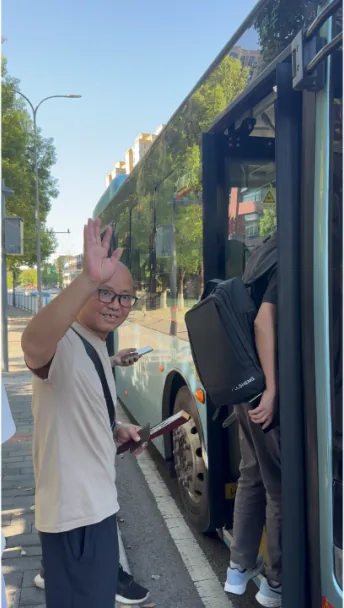
Going home after another discharge — the same bus route, the same afternoon card game waiting.
"Trust Your Doctors, Trust the Science"
Asked what he would tell other patients, Mr. Shi did not reach for anything grand.
"I want to say one thing to every patient like me — your mindset has to be good. Trust your doctors. Trust the medical technology we have now. This road is not easy, but it is not impassable. Look at me: I have been walking it for nine years, and I am still walking."
There is no storybook ending in his case, no vanished tumor, no dramatic reversal. There is only nine years of showing up on schedule — and then going home to live.
If those nine years contain a formula at all, it has three parts: trust your doctors, trust the science, and refuse to frighten yourself.
"There was no other option anyway — so you face it head-on."
Doctor's Note
From 2017 to 2026: A Decade of Progress, Witnessed Firsthand
Mr. Shi has lived through nearly ten years of progress in lung cancer treatment. From surgery to chemotherapy, from chemotherapy to immunotherapy, the arsenal in our hands has grown and patients' survival has lengthened. But the most important factor is always the patient's own conviction and cooperation. Mr. Shi has proved with nine years that the relationship between doctor and patient is one of fighting side by side.
— Director Luo Kuo, Oncology Center, Chongqing HYGEIA Hospital
His nine years have no cinematic plot. What they have is the plain resilience of an ordinary man from Chongqing refusing to accept that a diagnosis is a deadline. In his own way he has told everyone the same thing: cancer is not the end of the road, and life goes on.
May every Wukong out there get over his own mountain.
Expert Profile
Director Luo Kuo
Director, Oncology Center, Chongqing HYGEIA Hospital (HYGEIA Healthcare)
Director Luo Kuo leads the Oncology Center at Chongqing HYGEIA Hospital. His team manages advanced lung cancer with guideline-directed systemic therapy — molecular testing to identify targetable drivers, immunotherapy combined with chemotherapy for driver-negative disease, and long-term maintenance strategies designed around quality of life. The center also handles recurrence after long remission, where restaging and a fresh treatment plan are often required.
Facing a Stage IV Diagnosis — or a Recurrence?
HYGEIA Healthcare's international patient team can connect you with thoracic oncology specialists across our hospital network, arrange remote review of your pathology and imaging, and help with visa, travel, and interpretation.
Book a Consultation— Chongqing HYGEIA Hospital, HYGEIA Healthcare —
← Back to News