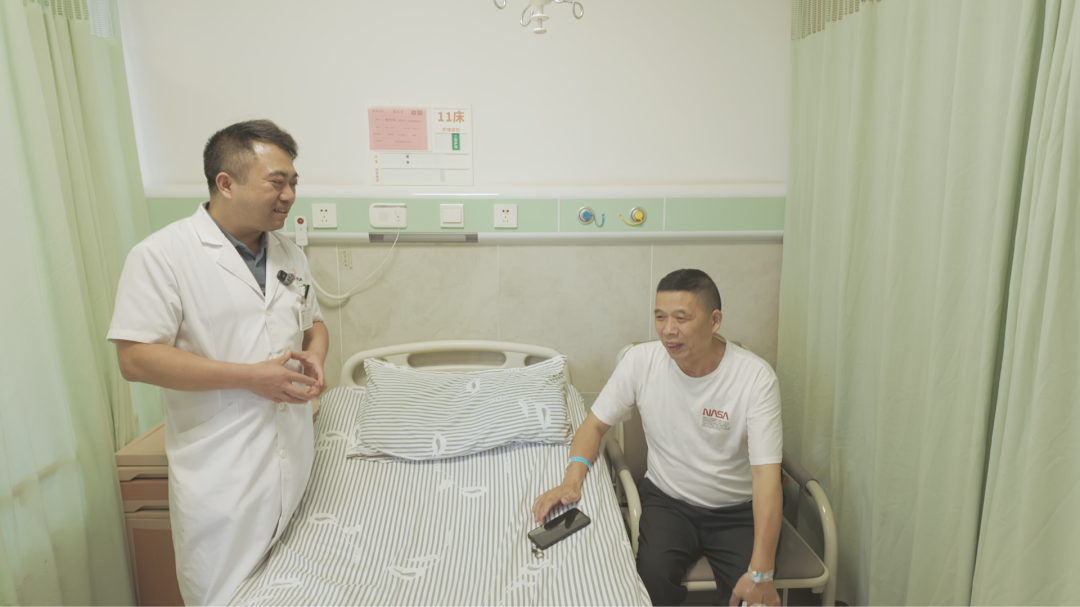
Mr. Yang discussing his recovery with Dr. Luo in the ward at Chongqing HYGEIA Hospital.
In the follow-up archives of Chongqing HYGEIA Hospital, Mr. Yang (pseudonym) is a special case. In 2019, he was diagnosed with esophageal cancer; in 2025, with extensive-stage small cell lung cancer that had already spread to his brain. Two primary tumors, two entirely different cancer types, seven long years of treatment — he not only survived, but lives well.
When medical imaging repeatedly showed his lesions receding and his tumor markers returning to normal, his doctors knew that beyond precise radiotherapy, chemotherapy, and immunotherapy, another invisible force was holding up his life. It lived in his wife's day-after-day persuasion, in every bowl of red peanut porridge, in every moment when "I don't want treatment anymore" was pulled back from the edge. It was a silent, family-powered form of "immunotherapy" — it does not kill cancer cells directly, but it lets a person choose to take one more step at the moment of deepest despair.
The Alarm Bell of Dysphagia: Strong and Healthy — How Did I Get Cancer?
In 2019, Mr. Yang noticed something wrong when he ate. Swallowing came with a distinct sense of obstruction — dry rice was nearly impossible to get down. "I could only drink thin liquids. Even slightly thick porridge wouldn't go down," he recalled.
At the time he weighed 93 kilograms, solid and strong, and hardly believed cancer could find him. But urged by his family, he went to the hospital for tests — esophageal cancer. The three words landed like a heavy blow. The pathology report left no room for denial.
"I thought, I'm so healthy — how could this happen?" But fate gave him little time to think. Treatment had to start immediately.
The First Battle: Thirty Radiotherapy Sessions, and He Could Eat Again
At the Oncology Center of Chongqing HYGEIA Hospital, the team led by Dr. Luo Kuo designed a radical radiotherapy plan for him. More than thirty sessions of radiotherapy followed — an exhausting process with burning skin and persistent fatigue — but he gritted his teeth and saw it through.
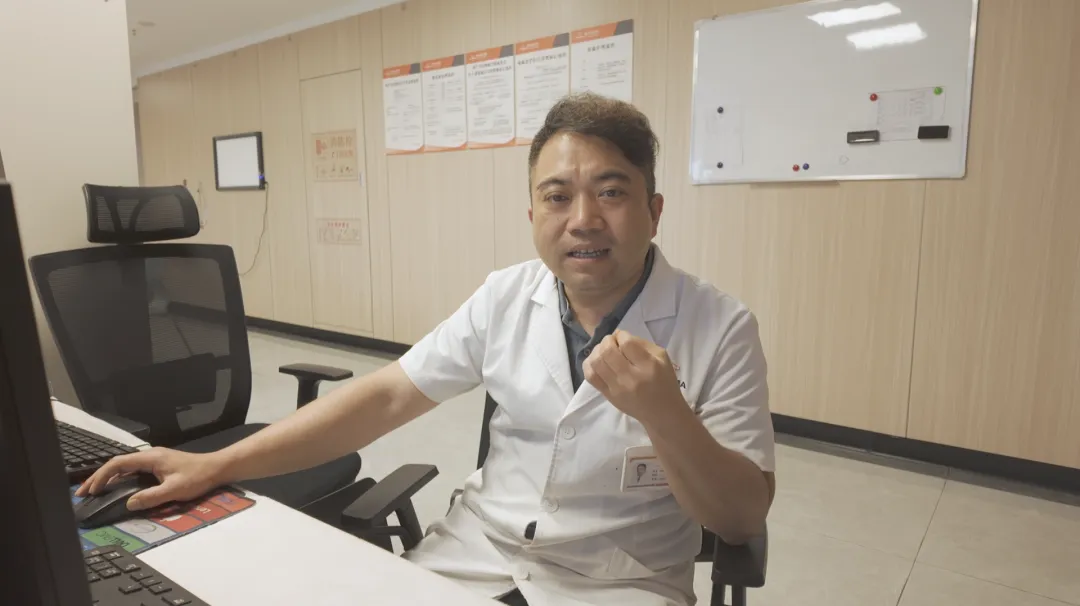
Dr. Luo Kuo, Director of the Oncology Center at Chongqing HYGEIA Hospital.
The results came faster than expected. "Halfway through the radiotherapy, I felt better. I could eat," Mr. Yang said, his voice still carrying a trace of relief. After the course ended, the esophageal lesion was completely controlled. In the years of follow-up that followed, there was no recurrence — and no radiation pneumonitis, esophageal stricture, or other late effects. He returned to a normal diet, his weight stabilized, and his quality of life improved dramatically.
His first fight against cancer was won — cleanly.
Fate Deals Again: Six Years Later, Lung Cancer Appears
Time moved to 2025, six years after the esophageal cancer diagnosis. During a routine follow-up, a new lesion was found in his lung: extensive-stage small cell lung cancer, already metastasized to the brain. It was an aggressive, rapidly progressing type — a completely different opponent from esophageal cancer.
"When the second tumor came, of course the psychological pressure was there," Mr. Yang admitted. The confidence from his first victory wavered in the face of a new and more dangerous enemy. He even considered giving up treatment altogether.
This time, his wife stepped forward again. "He didn't want to come anymore. Our whole family kept persuading him, and in the end he agreed," she said. She offered no grand arguments — just persistent, patient encouragement, day after day, pulling him back from the edge of giving up. She understood better than anyone: he wasn't afraid of treatment. He was afraid of burdening his family.
Comprehensive Treatment: Chemotherapy + Immunotherapy + Precision Radiotherapy
For extensive-stage small cell lung cancer, the team applied the standard approach — chemotherapy combined with immunotherapy — along with precise radiotherapy to the residual chest lesion and the brain metastases.
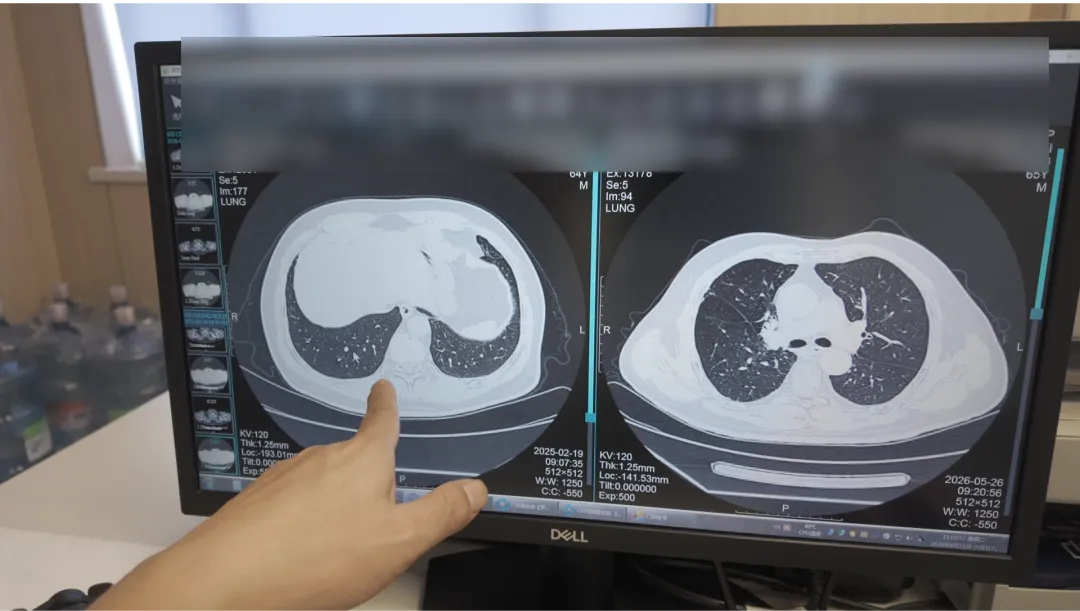
Follow-up CT imaging showing the lung lesions under control after comprehensive treatment.
The process was not easy. His weight dropped, his body weakened, and walking became unsteady. But the treatment worked quickly. "After the immunotherapy, I felt comfortable. The pain was gone, and I could walk normally again," Mr. Yang described. His tumor markers fell to normal levels, imaging showed the lesions had shrunk significantly, and the brain metastases came under control. Today his weight has recovered, his spirits are good, and he moves freely.
Financial Pressure and Individualized Adjustment: The Wisdom of Tailored Medicine
Mr. Yang's family is of modest means. After about one year of maintenance immunotherapy, the cost of continuing the standard cycle became unsustainable. It is a dilemma familiar to many cancer families — the drug works, but it cannot be afforded.
Rather than rigidly insisting on the standard protocol, the medical team adjusted the plan flexibly, extending the immunotherapy interval from once every three weeks to once every five to six weeks. "Once immunotherapy is activated, the immune system may remain in an activated state for a long time, continuously suppressing the tumor," Dr. Luo explained. "We don't have to use the most expensive drugs. Within what the patient can bear, we tailor the treatment — and deliver the most appropriate maintenance therapy."
This pragmatic, middle-path strategy has kept Mr. Yang's disease stable even after intensive maintenance ended. To this day there is no evidence of active tumor. Sometimes the wisdom of medicine lies not in "using the best," but in "using what fits."
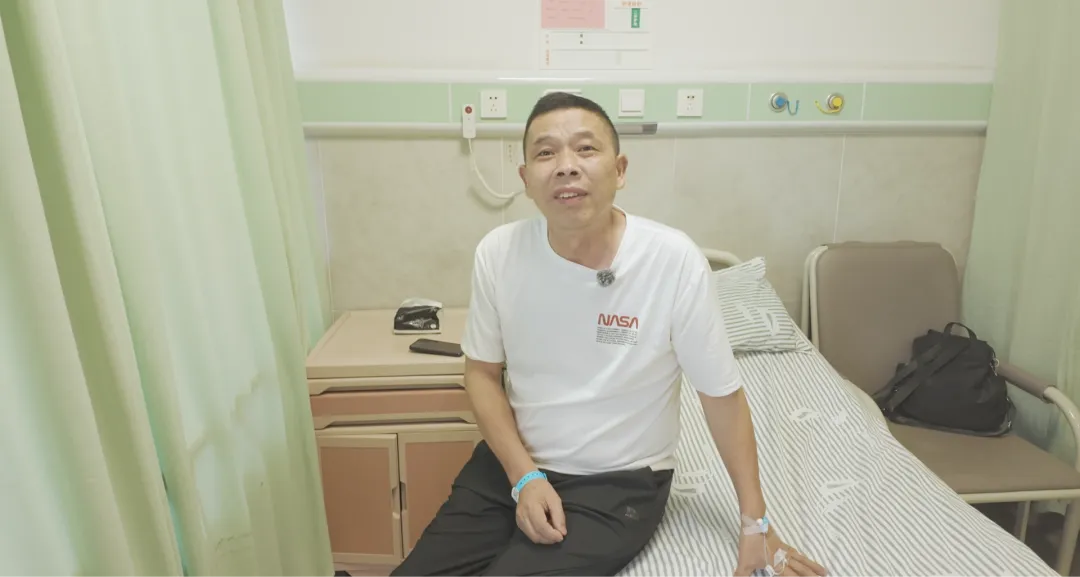
Mr. Yang during his interview in the ward — weight recovered, spirits high.
Belief and Support: A Battle No One Fights Alone
Looking back on nearly seven years of fighting cancer, Mr. Yang is deeply grateful to his wife and family for never leaving his side. "A family's love matters so much. If I had been alone, I might have given up long ago," he said. "My wife kept persuading me, encouraging me in every way she could — that's the only reason I made it to today."
He also praised the medical team at HYGEIA warmly: "The doctors, nurses, and the director are all wonderful. Their service is good and they take responsibility. Whenever something came up, they explained everything patiently, softly, word by word." In his weakest and most irritable moments, those gentle explanations and reassurances were like a hand pulling him out of the swamp of despair, again and again.
He believes that alongside standard treatment, mindset and nutrition matter just as much. "With this disease, you have to keep a good attitude — you recover faster that way." He shared his dietary remedies: red peanut porridge and loach soup to help raise his white blood cell count and rebuild his strength. In these simple foods lived his wife's quiet, daily devotion.
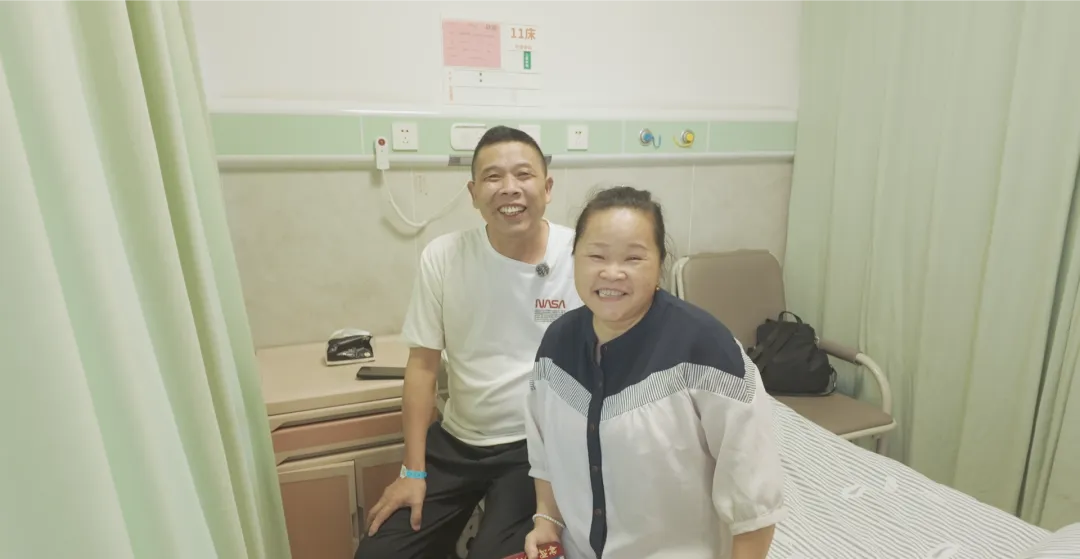
Mr. Yang and his wife in the ward — the invisible "immunotherapy" of family support.
The Doctor's Perspective: Real-World Treatment Wisdom
"Mr. Yang is a classic case of dual primary tumors, and both treatments succeeded," Dr. Luo summarized. "His esophageal cancer has shown no recurrence since radical radiotherapy, and his lung cancer — treated with chemotherapy, immunotherapy, and radiotherapy — has achieved survival of more than two years with stable disease. That is thanks to the comprehensive treatment model, and to family and social support."
He stressed that cancer treatment is not only the doctor's business, nor only the patient's — it belongs to the whole family, and to society. "Many patients are impoverished by illness, unable to work, with limited income. We need to choose individualized plans within what patients can afford, so that they truly benefit."
"Immunotherapy can bring long-term survival to about one in three patients. But if you don't try, there is no hope at all."
Dr. Luo urged more patients to follow Mr. Yang's example: never give up, and give standard treatment a chance. In seven years, he has seen too many people give up — and too many others, like Mr. Yang, persuaded to come back by their families. He knows a doctor's weapons are not only prescriptions and radiation beams, but also the encouragement of "let's try again." Sometimes, one sentence saves a life.
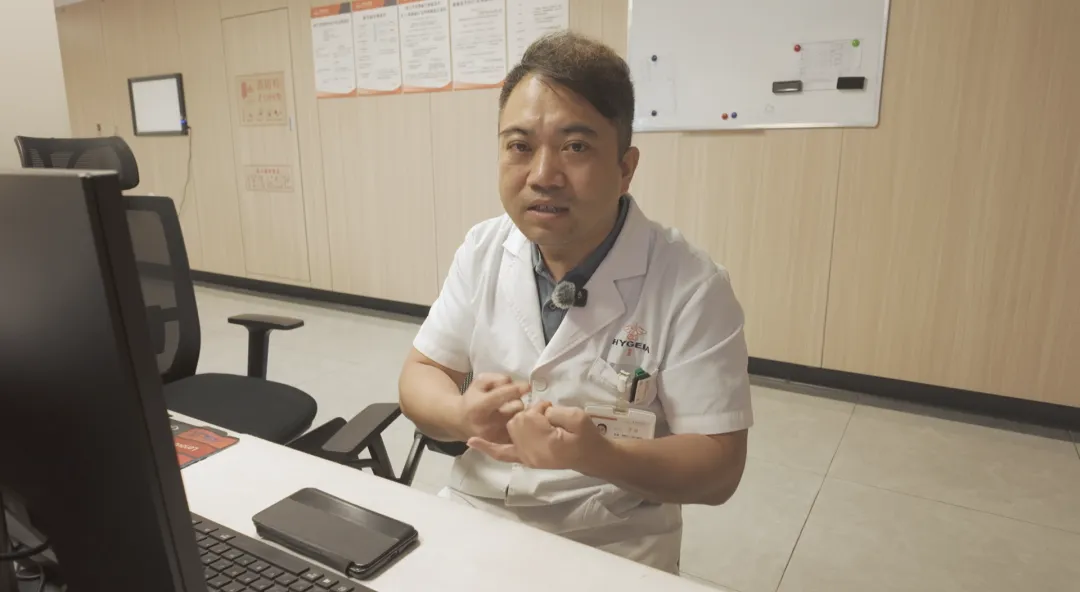
Dr. Luo Kuo during the interview — calm, steady, and certain.
The Road Is Long, but Walking It Will Get You There
Two cancers, seven years. Mr. Yang endured physical suffering, financial strain, and psychological torment — yet through standard medical care, his family's companionship, and his own perseverance, he made it through, time after time. Today his weight is back, his steps are steady, and his follow-up results are good. "Thank you to my wife, to my doctors, and to everyone who helped me," he said. His story holds no miracle — only the real trajectory of a life woven from science, persistence, and love. As he told fellow patients facing the camera: "Don't worry and don't despair. Keep a good mind, keep an open heart, and you will recover faster. Trust the hospital, and keep fighting."
Expert Profile
Dr. Luo Kuo
Director of Oncology Center, Chongqing HYGEIA Hospital
Dr. Luo Kuo leads the oncology center at Chongqing HYGEIA Hospital, overseeing multidisciplinary care for esophageal cancer, lung cancer, and other solid tumors. He is known for combining rigorous, evidence-based protocols with pragmatic, individualized treatment plans that respect each patient's real-world circumstances — accompanying patients from active treatment through long-term survivorship.
Facing Cancer — Even a Second Time?
HYGEIA Healthcare's international patient team can connect you with experienced oncology centers for radiotherapy, chemotherapy, immunotherapy, and comprehensive cancer care across our nationwide hospital network.
Book a Consultation— Chongqing HYGEIA Hospital, Brand & Communications Department —
← Back to News