From "Urinary Problem" to Malignant Tumor
Eight months ago, a 17-year-old girl began experiencing discomfort in her lower back and sacral region. She then gradually developed difficulty urinating. At first, she and her family thought it was a routine urinary tract issue. After visiting multiple hospitals without a clear answer, her symptoms kept worsening. Eventually, detailed imaging confirmed the diagnosis: sacral nerve malignant tumor.
The disease progressed rapidly. Within the past month, she developed severe pain in her left lumbosacral region and buttock that disrupted sleep, increasing numbness, limited mobility of her left lower limb, inability to sit or stand for long periods, incomplete bladder emptying, and constipation. Her pain score reached 6 out of 10.
After seeking opinions at several centers, the family came to Chongqing HYGEIA Hospital. There, the hospital's oncology center director Dr. Zhang Jinshun led a multidisciplinary team (MDT) evaluation involving urology, orthopedics, neurosurgery, gynecology, interventional radiology, and rehabilitation medicine.
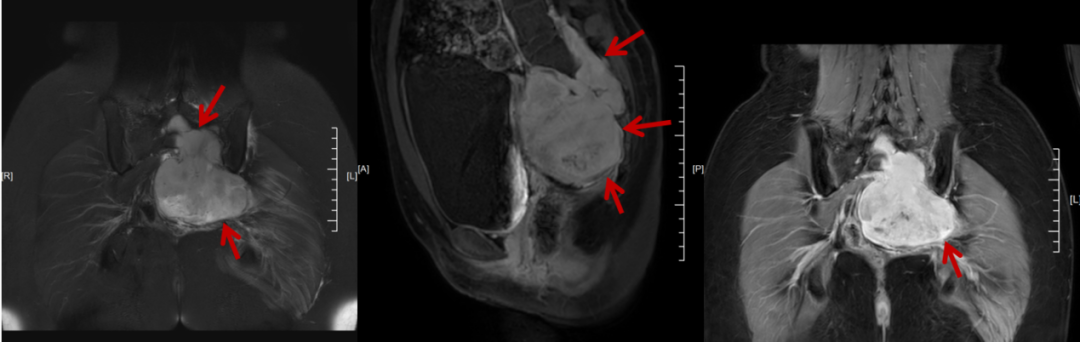
Pre-operative MRI: Sacral nerve malignant tumor located deep in the pelvic cavity. Red arrows indicate the tumor mass and its close relationship to surrounding blood vessels, nerves, and pelvic organs.
The Decision: Cut Off the Tumor's Food Supply
Faced with these competing risks, the MDT team asked a different question: instead of removing the tumor directly, could they cut off its lifeline? The answer was transcatheter arterial chemoembolization (TACE).
Tumors need a constant blood supply to grow. As they enlarge, they release signaling factors that stimulate new blood vessel formation, creating a dense feeding network. By blocking these feeding arteries, the tumor is deprived of oxygen and nutrients, stops growing, and gradually undergoes necrosis. This is the core principle of how embolization "starves" a tumor.
Technical Innovation: Brachial Artery Access
The conventional approach for TACE is puncture of the femoral artery at the groin. However, this patient was in such severe pain that she could not lie flat for the required post-procedure immobilization. Vice President Zhou Peihua led the interventional team to choose an alternative: brachial artery access through the upper arm.
Under real-time DSA guidance, the team inserted a 1.67-millimeter-diameter catheter into the brachial artery and advanced it toward the tumor-feeding arteries. Once the catheter tip was precisely positioned inside the target vessel, the team delivered chemotherapy combined with embolic material directly into the tumor's blood supply. This dual-action approach simultaneously deprives the tumor of nutrients and kills cancer cells locally.
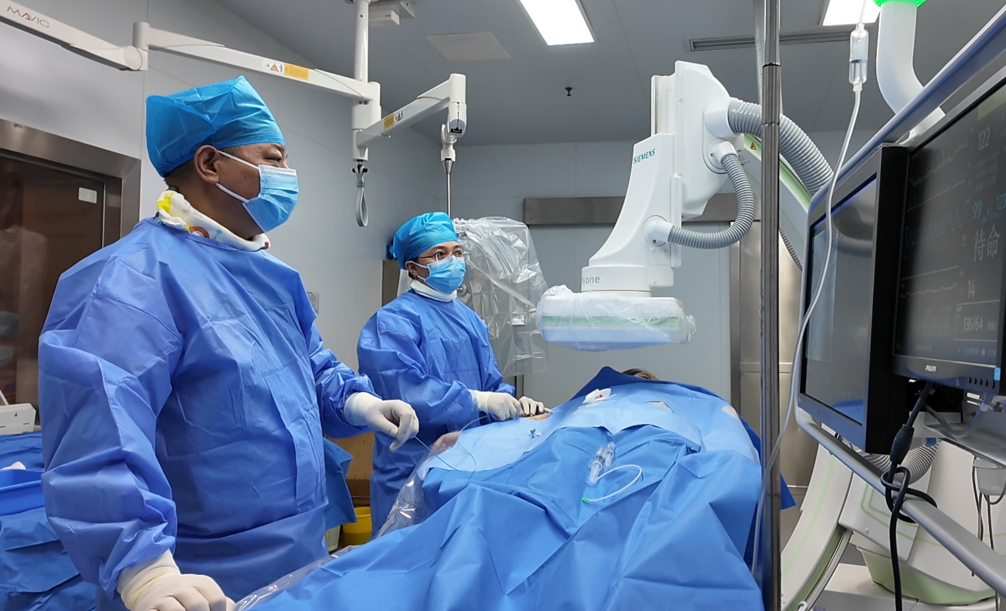
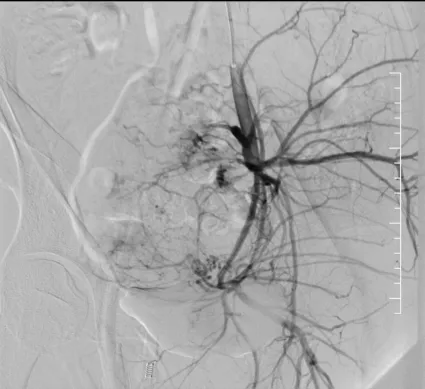
Pre-embolization DSA angiogram: Dense, abnormal tumor vascularity supplying the sacral nerve malignancy — the "food supply" the team needed to interrupt.
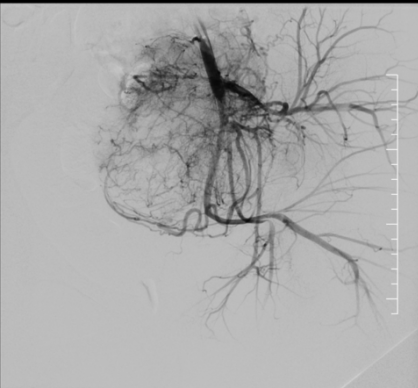
Post-embolization DSA angiogram: Significant reduction in tumor vascularity after chemoembolization, confirming successful interruption of the tumor's arterial supply.
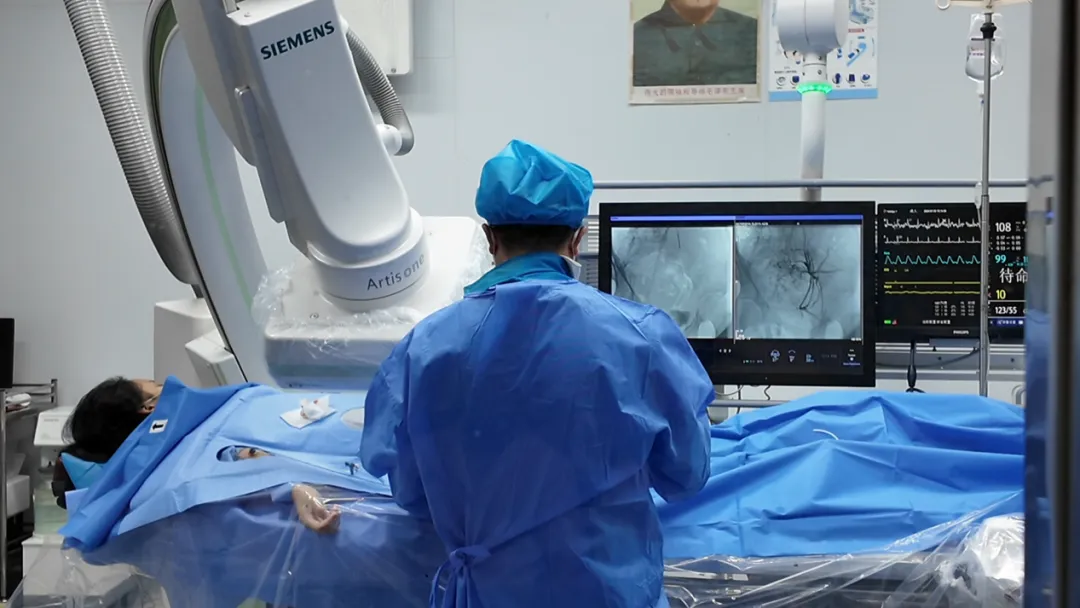
The interventional oncology team performing TACE in the DSA suite at Chongqing HYGEIA Hospital. Real-time fluoroscopic guidance allows sub-millimeter precision in catheter navigation.
Rapid Recovery After the Procedure
The minimally invasive procedure paid off quickly. The patient did not require open surgery and recovered with only a tiny puncture site at the upper arm.
On post-operative day 3, pain in the left sacral region was noticeably reduced, and the left lower limb could move slowly. She regained spontaneous urination and defecation.
By post-operative day 6, her lumbosacral pain had substantially improved, with the pain score dropping to 1 out of 10. Difficulty with urination and defecation was relieved, bowel and bladder function normalized, and she was able to stand and walk with assistance.
Vice President Zhou Peihua (left) and the interventional team performing the TACE procedure. The brachial approach was chosen specifically because the patient could not tolerate prolonged supine positioning after femoral access.
Four Key Advantages of TACE
- Minimal trauma, fast recovery: No open incision — only a needle-puncture access site. Performed under local anesthesia in most cases, with patients often able to get out of bed within 24 hours.
- Precise targeting, fewer systemic side effects: In conventional intravenous chemotherapy, only about 5% of the drug reaches the tumor after circulating through the body. With TACE, chemotherapy is infused directly into the tumor-feeding artery, achieving local drug concentrations up to 10 times higher than IV delivery — while reducing nausea, vomiting, and bone marrow suppression.
- Definitive local effect: By blocking blood supply and delivering high-concentration chemotherapy, TACE can control tumor growth, shrink the tumor, or cause necrosis. Clinical data show that TACE can improve 1-year survival in intermediate-to-advanced liver cancer from about 30% to 65%.
- Repeatable: For patients with multiple lesions or recurrent disease, TACE can be performed multiple times to achieve long-term disease control. Large tumors can also be downsized before definitive surgery.
Which Tumors Can Be Treated with TACE?
TACE is especially suitable for hypervascular solid tumors — tumors whose growth depends heavily on a rich blood supply. Common indications include:
- Liver cancer (HCC), lung cancer, kidney cancer, pancreatic cancer
- Cervical cancer, ovarian cancer, bone tumors
- Colorectal cancer liver metastases
- Head and neck tumors
For patients with inoperable intermediate-to-advanced tumors, TACE can serve as effective palliative therapy. For large tumors, it can shrink the mass and create better conditions for subsequent surgery or other treatments.
A Safer Path for a Young Patient
For this 17-year-old girl, conventional open surgery posed unacceptable risks to bowel, bladder, and leg function. Chongqing HYGEIA Hospital's MDT approach — led by oncology, interventional radiology, urology, orthopedics, neurosurgery, and rehabilitation — identified a personalized solution. The brachial-artery TACE procedure not only avoided the need for prolonged supine positioning but also delivered a precise, minimally invasive strike against the tumor. This case reflects HYGEIA's commitment to multidisciplinary, patient-centered oncology care.
Expert Team
Dr. Zhang Jinshun
Director of Oncology Center, Chongqing HYGEIA Hospital
Led the multidisciplinary evaluation and treatment planning for this complex sacral nerve malignancy. Coordinated input from oncology, urology, orthopedics, neurosurgery, gynecology, interventional radiology, and rehabilitation to select the safest and most effective treatment path.
Vice President Zhou Peihua
Vice President & Interventional Team Leader, Chongqing HYGEIA Hospital
Designed and led the brachial-artery TACE procedure. Chose the upper-arm access route specifically to accommodate the patient's inability to lie flat after conventional femoral puncture, demonstrating adaptive, patient-centered interventional strategy.
Media Coverage
This case has been reported by mainstream media in Chongqing:
- Chongqing Voice Radio (重庆之声) — Featured report on the hospital's interventional oncology capabilities
- Chongqing Eye / Di Yi Yan (第1眼) — Patient story and treatment journey
- Hualong Net (华龙网) — News coverage of the multidisciplinary tumor treatment
Complex Tumor Case? Explore Interventional Oncology in China
Contact HYGEIA Healthcare's international patient team to learn about TACE, tumor embolization, and multidisciplinary oncology care across our nationwide hospital network.
Book a Consultation— Chongqing HYGEIA Hospital, Brand & Communications Department —
← Back to News