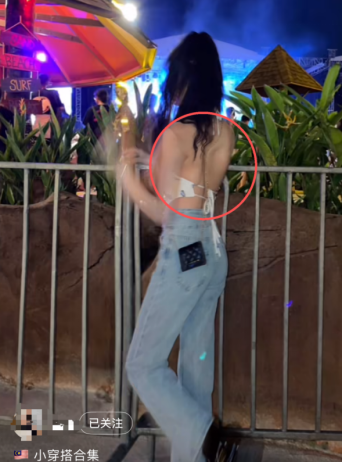
Before treatment: The visible spinal curvature that affected Xiao Ya's daily life and professional confidence.
"I Can Wear Backless Dresses Again"
"I can wear backless dresses again!"
On May 12, 2026, 23-year-old fashion blogger Xiao Ya* (alias) was discharged from Chongqing HYGEIA Hospital with a bright smile and a grateful heart. One year earlier, she had been diagnosed with severe scoliosis — her maximum Cobb angle exceeded 67°, creating a prominent rib hump on her back, uneven shoulders, and persistent back pain that interfered with both her daily life and her career as a content creator.
To save her profession and her self-confidence, she sought help from multiple hospitals before finding her answer at Chongqing HYGEIA Hospital. There, under the care of Dr. Chen Yuanze — Director of the Bone and Trauma Center — and assisted by navigational robotic technology, her spinal deformity was successfully corrected in approximately 4 hours.
"I can wear backless dresses again!" — Xiao Ya's first words upon discharge from Chongqing HYGEIA Hospital, smiling as she made a heart gesture to the nursing team.
The Condition: When Your Spine Bends Sideways
Scoliosis is not just about posture — it is a three-dimensional spinal deformity where the spine curves sideways, often accompanied by vertebral rotation. For Xiao Ya:
- Her family first noticed something wrong when they observed an uneven shoulder height and abnormal back contour
- A local hospital diagnosed scoliosis but offered no systematic treatment plan
- Over the next few months, symptoms worsened: back pain intensified, and the rib prominence became visible even through clothing
- In her videos, viewers' comments shifted from "where did you get that outfit?" to "Is your back crooked?"
Diagnosis at HYGEIA: A Clear Picture
Upon admission to Chongqing HYGEIA Hospital on April 22, 2026, Dr. Chen Yuanze's team conducted a comprehensive evaluation:
- Physical examination: Uneven shoulders (right shoulder elevated), prominent right thoracic rib hump — classic "scapular prominence"
- Adam's forward bend test: Positive — confirming structural scoliosis
- Full-spine X-ray: Revealed dual-major curve scoliosis (thoracolumbar)
- Cobb angle measurement: >67° — well above the threshold for surgical intervention
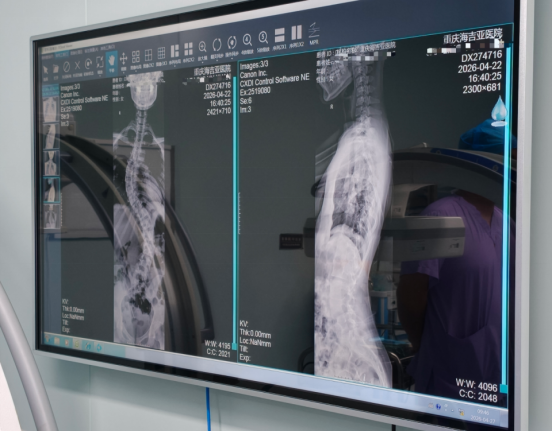
Pre-operative planning: High-resolution X-ray imaging allows the surgical team to map each vertebra and plan precise screw placement trajectories.
The Solution: Robot Navigation Meets Surgical Artistry
Chongqing HYGEIA Hospital's Bone and Trauma Center has established itself as a leader in complex spinal procedures. The center now routinely performs:
- Robot-assisted spinal surgery
- Intraoperative navigation
- Neurophysiological monitoring
This creates a complete clinical pathway: Conservative Treatment → Minimally Invasive Surgery → Deformity Correction → Functional Reconstruction.
The Three-Pillar Approach
Xiao Ya's surgery combined three advanced technologies working in perfect synchronization:
Millimeter Precision
Real-time Safety
1,000+ Spine Cases
- Robotic Navigation — The system creates a precise 3D "map" of the patient's spine, calculating the optimal trajectory for every pedicle screw placement. It acts like GPS for the surgeon's instruments.
- Intraoperative Neurophysiological Monitoring — Acts as a real-time "sentinel," continuously monitoring nerve signals throughout the procedure. Any change in signal patterns alerts the surgical team instantly, protecting the spinal cord.
- Dr. Chen Yuanze's Expertise — With over 1,000 spinal surgeries performed, Dr. Chen translates the robot's data into precise physical execution. Screw placement error is controlled to the millimeter level.
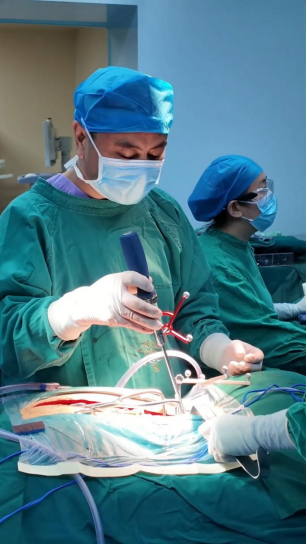
Intraoperative view: Dr. Chen Yuanze performing robot-navigated pedicle screw placement during the spinal correction procedure.
The Procedure
(Full name: Posterior Spinal Correction + Pedicle Screw Internal Fixation + Posterolateral Fusion under Neural Monitoring, Navigation, and Robotic Assistance)
The entire procedure took approximately 4 hours. During this time, the team achieved what would have taken significantly longer using conventional methods:
- Precise screw placement along the entire curved segment of the spine
- Gentle derotation and correction of the spinal column
- Rigid internal fixation to maintain the corrected alignment
- Bone grafting to promote permanent fusion
The Results: Numbers That Tell a Story
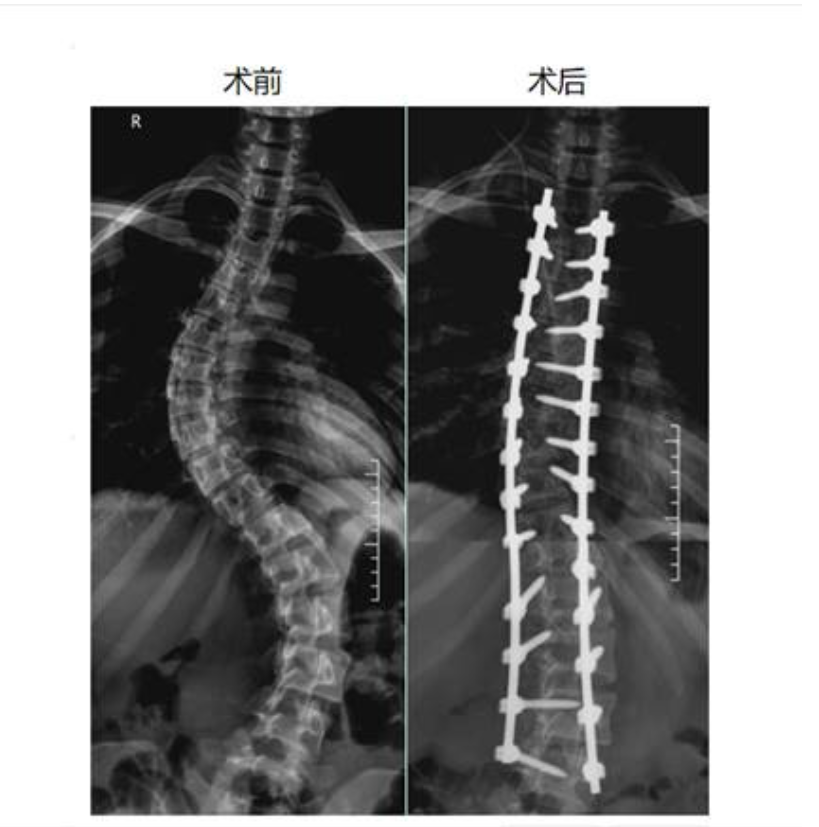
Before vs. After: Pre-operative X-ray shows a 67° Cobb angle with severe spinal curvature. Post-operative image reveals near-normal alignment following robot-assisted correction surgery.
Correction
| Metric | Before Surgery | After Surgery |
|---|---|---|
| Cobb Angle | ~67° (Severe) | ~10° (Near Normal) |
| Shoulder Level | Uneven (Right higher) | Restored to Level |
| Rib Hump ("Scapular Prominence") | Prominent | Essentially Resolved |
| Height | — | +7 cm Gained |
| Back Pain | Persistent, Daily | Resolved |
Recovery: Faster Than Expected
Xiao Ya's recovery timeline demonstrates the benefits of precision-guided surgery:
- Day 2 post-op: Walking with a supportive brace
- Day 10 post-op: Started rehabilitation training
- Day 20 post-op: Discharged home
Upon discharge, Xiao Ya walked to the nurses' station to bow deeply in gratitude to the team who gave her back her posture — and her confidence.
The Expert Behind the Success
Dr. Chen Yuanze
Director, Bone and Trauma Center — Chongqing HYGEIA Hospital
Dr. Chen leads one of the region's most advanced spinal surgery programs. With more than 1,000 spine operations to his name, he specializes in complex spinal deformities including scoliosis, kyphosis, and revision surgeries. His integration of navigational robotics with traditional surgical technique has set new standards for precision in spinal correction at HYGEIA Healthcare.
Spinal Health: An Important Message
Dr. Chen emphasizes that early detection of scoliosis is critical, especially among adolescents:
Early warning signs parents should watch for:
- Uneven shoulder heights or hip levels
- One shoulder blade protruding more than the other
- Visible spinal curve when bending forward
- Chronic, unexplained back pain in children or teenagers
- Long-term habit of carrying heavy bags on one shoulder
- Prolonged poor sitting posture during study or screen time
When detected early, many cases of scoliosis can be managed conservatively with bracing and physical therapy, avoiding the need for surgical intervention altogether. But when surgery becomes necessary — as it did for Xiao Ya — having access to advanced technology and experienced specialists can make all the difference between living with limitations and reclaiming your life.
Conclusion: Technology and Humanity, Working Together
Xiao Ya's story illustrates what modern medicine at its best looks like: cutting-edge technology serving human needs. The robot provides millimeter-level accuracy. The neural monitor ensures safety at every moment. And Dr. Chen Yuanze brings decades of hands-on judgment, adaptability, and compassion.
For patients traveling internationally for medical care, this level of integrated expertise — combining state-of-the-art equipment with deeply experienced surgical teams — is precisely what makes HYGEIA Healthcare a destination worth considering.
Considering Spinal Treatment in China?
If you or someone you know is dealing with scoliosis or other spinal conditions, contact HYGEIA Healthcare's international patient team for a remote consultation and personalized treatment plan.
Book a Consultation— Chongqing HYGEIA Hospital, Brand & Communications Department —
*Patient name changed to protect privacy. Coverage also reported by Hualong Net, Chongqing Voice Radio, and First Eye News.
← Back to News